Some courses from the catalogue
Taught in TurkishLLM'ler Gerçekte Nasıl Çalışır
The Turkish edition of the same field guide: every lesson, diagram and question translated, with code and menu paths left exactly as they appear on screen.
- Estimated duration
- about 5 hours
- Lessons
- 14 in 4 parts
- Questions
- 180, incl. a 40-question final
- Diagrams
- 68
- Format
- Self-paced, in the browser
The same course in English: “How LLMs Actually Work” →
The same course as its English edition, taught in Turkish for teams who would rather learn in their own language. The through-line is unchanged: the model does not learn while you chat with it, because the application re-sends the whole conversation on every request. From there it covers the context window, what “memory” really is, tool use and MCP, RAG, AI security basics and fine-tuning open models. Code, JSON field names and Open WebUI menu paths stay in English, because that is what the learner sees on screen.
One animation from the material
Watch the payload grow — in Turkish
Drawn from lesson 3 of the Turkish edition, with its own labels. Each request re-sends the whole conversation — two messages the first time, four the second — and after every answer the model keeps nothing. The course shows this as a sequence diagram; this animation was made for this page.
Who it is for
- Teams who prefer to learn a technical subject in Turkish
- Network, security and systems engineers who are asked whether an AI tool is safe to connect to anything that matters
- Software developers about to build on an LLM API for the first time
- Sales, pre-sales and management staff who need to talk about AI with specifics
- Administrative staff who already use an AI assistant every day
Before you start
- No maths and no code. Every idea is explained in words and a diagram first; the few JSON examples are read, never written.
- Having used a chat assistant such as ChatGPT or Claude a few times helps, because the course starts from that experience.
- Reading Turkish. English is needed only to recognise field names and menu labels, which the course leaves as they appear on screen.
- Optional: access to an Open WebUI instance, to repeat the course's experiments on a real assistant.
What you will be able to do
- Explain in one sentence each what an LLM, a token and a context window are — and why the whole context window travels with every request.
- Read the actual JSON of a request and point at its system, user and assistant parts.
- Describe step by step what happens when a model uses a tool or an MCP server — including the fact that the model never executes anything itself.
- Change a system prompt in Open WebUI and predict what it will, and will not, change.
- Tell prompting, retrieval (RAG) and training a model apart, and say which one a given problem needs.
- Describe how an open model is fine-tuned on a company's own data, and roughly what that costs in people, hardware and time.
- Answer a customer or a colleague who asks “is it secure?” with specifics rather than reassurance.
Curriculum
Part and lesson titles appear exactly as they do in the course, in the course's own language; the line under each part is the question it answers.
Bölüm 1 — Zihinsel Model
What is this thing, where does its knowledge come from, and why doesn't it learn from me?
- 1. Bir LLM Gerçekte Nedir
- 2. Bilgi Nereden Geliyor
- 3. Sohbet Ederek Onu Eğitmiyorsunuz
Bölüm 2 — Bir İsteğin Anatomisi
What is literally sent over the wire, and what makes it look like memory?
- 4. Bir İstek Gerçekte Nasıl Oluşturulur
- 5. Sistem, Kullanıcı ve Asistan Mesajları
- 6. Bağlam Penceresi
- 7. "Hafıza" Gerçekte Nedir
Bölüm 3 — Dış Dünyaya Uzanmak
How does a text predictor search the web, query a database or send an email?
- 8. Araç Kullanımı — Akış
- 9. MCP — Evrensel Adaptör
- 10. RAG — Kaynağa Dayalı Yanıtlar
- 11. Hepsini Bir Araya Getirmek
Bölüm 4 — Şirkette Çalıştırmak
How do we keep it safe, when do we train our own, and what does it mean for my job?
- 12. Yapay Zekâ Güvenliğinin Temelleri
- 13. Açık Modelleri Kendi Verinizle Eğitmek
- 14. Bunun Sizin Rolünüz İçin Anlamı
Appendices
- A. Bir LLM Nasıl Üretilir
- B. 2017'den Sonra Ne Değişti
- C. Klasik Makine Öğrenmesi ve LLM'ler
- D. Sözlük
Assessment
Every lesson ends with a ten-question knowledge check and the course closes with a forty-question final exam, all translated into Turkish. The answer keys are identical to the English edition's, so results mean the same thing in both languages; questions and options are shuffled on every attempt, and attempts are recorded.
Sample pages
Captured from the course's own build. The platform's sign-in controls and the learner's personal panels are left out of the frame; everything else is the page as a learner sees it.
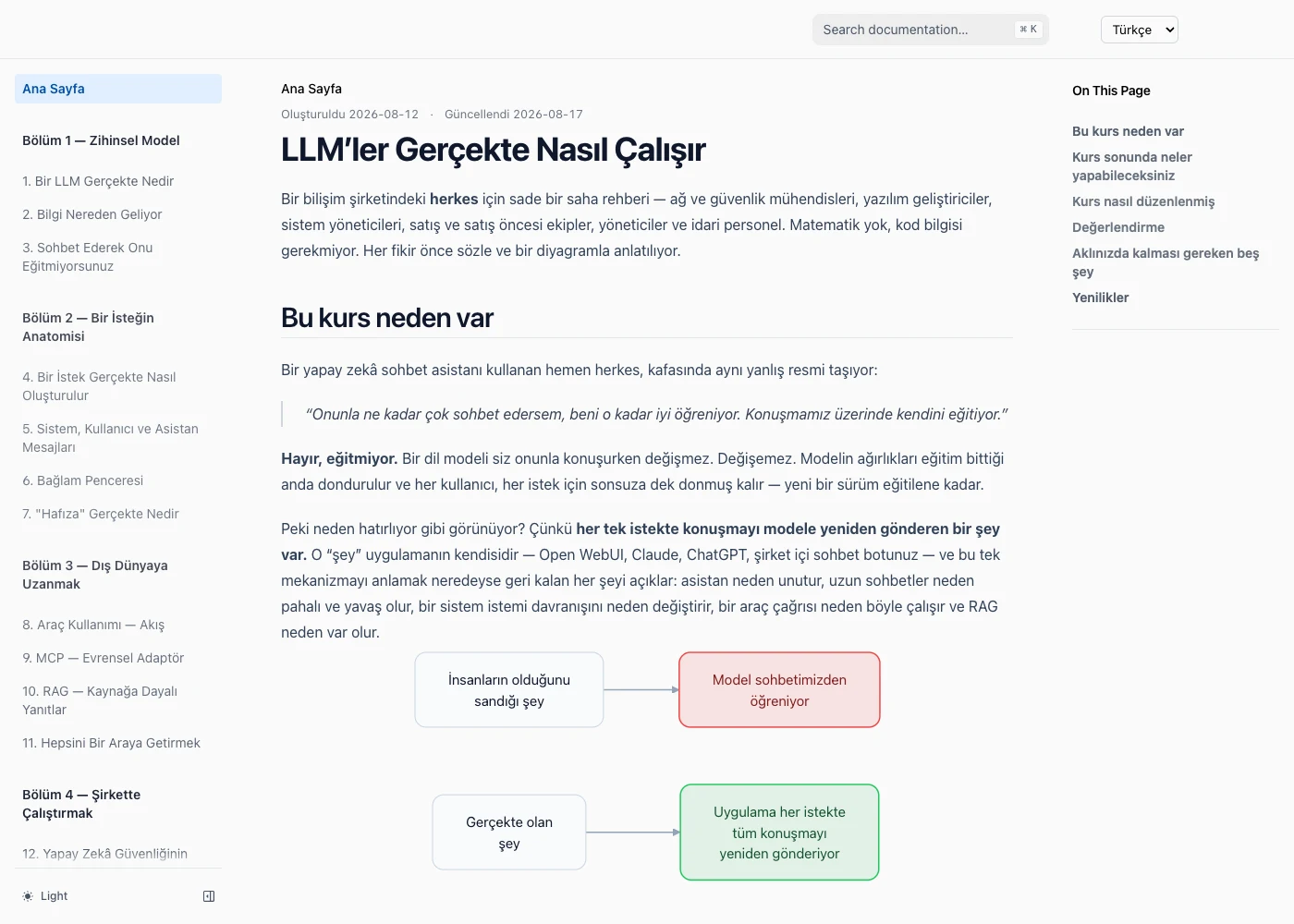
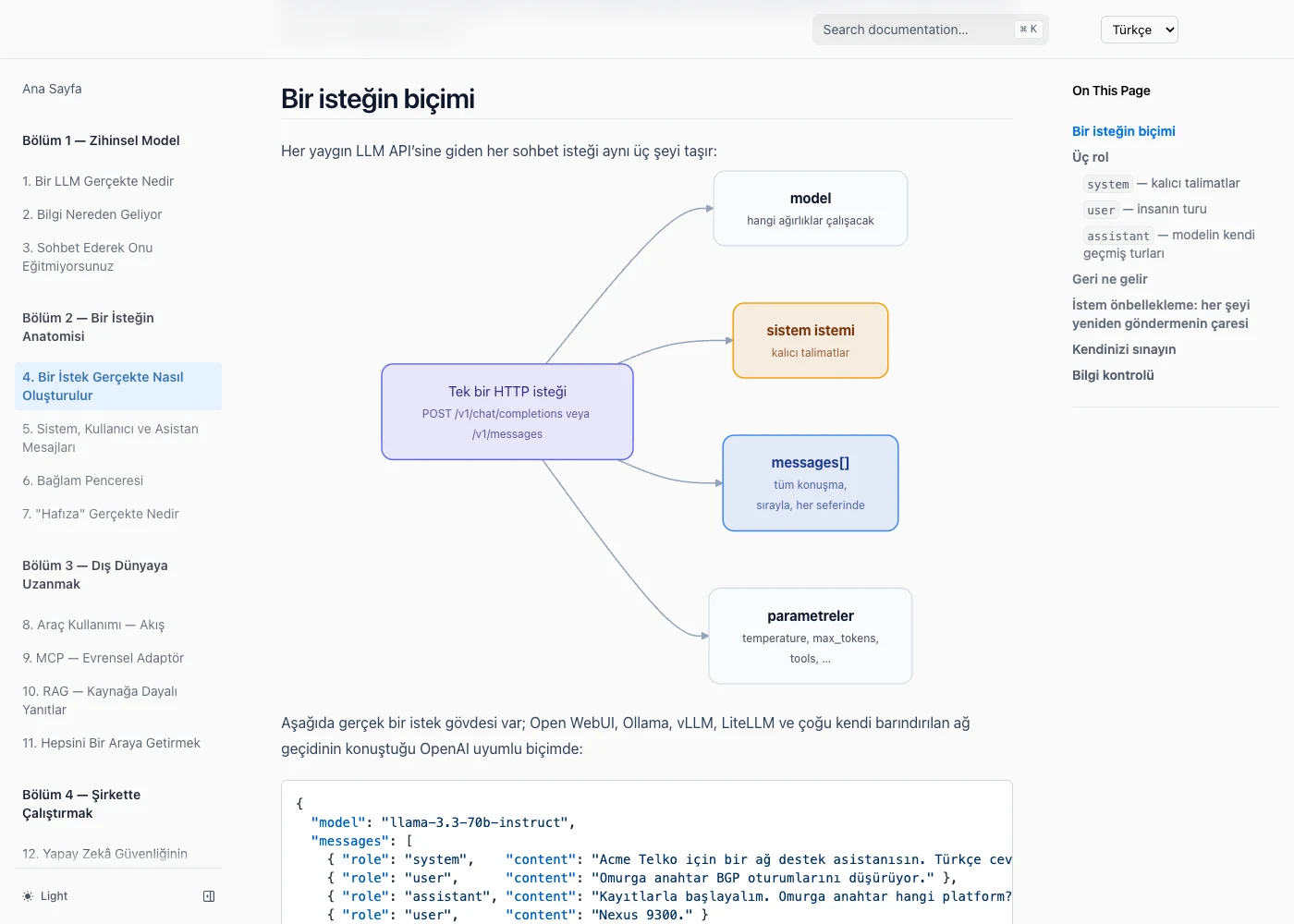
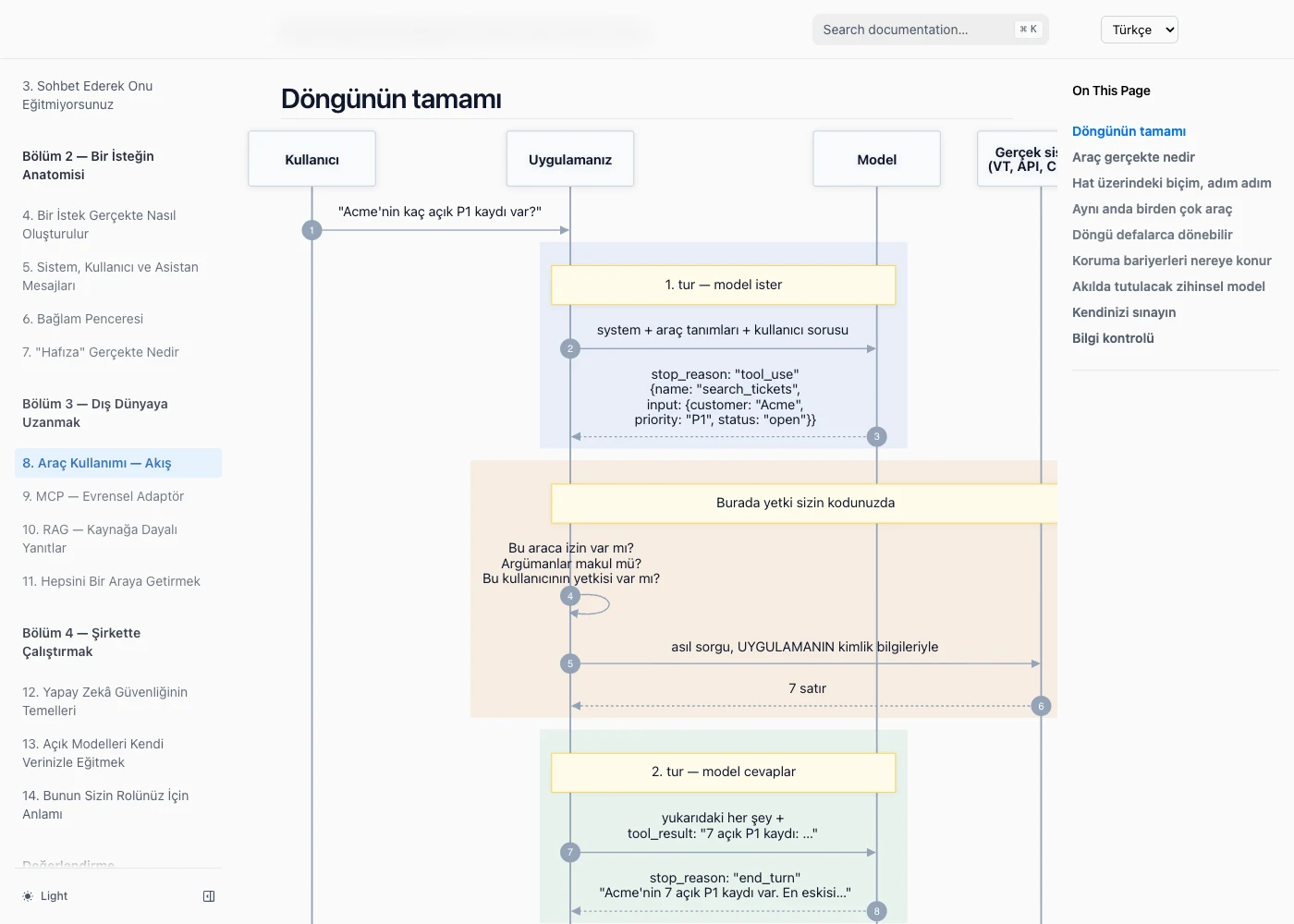
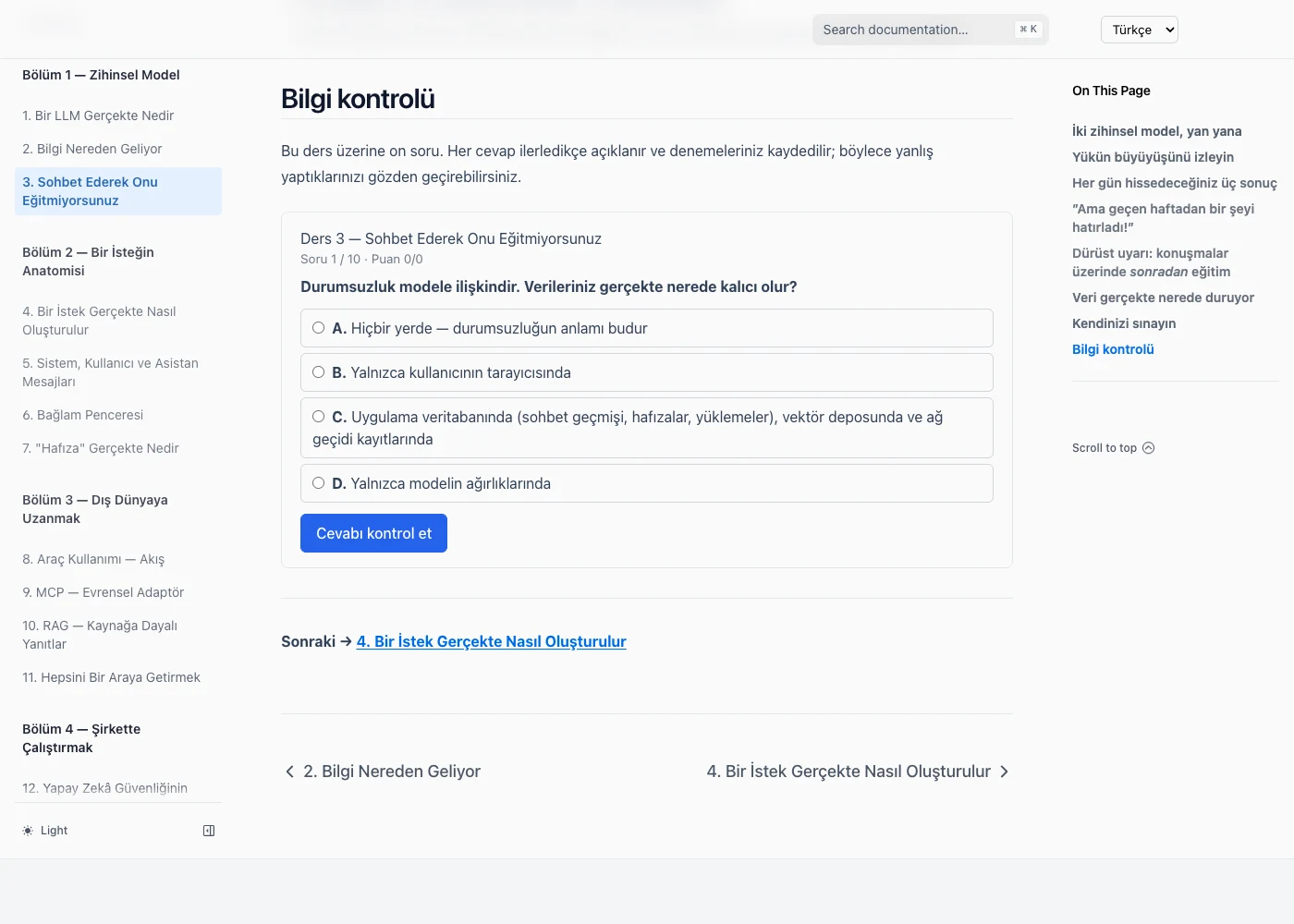
The duration is an estimate made from the course itself: 14,101 words read at 170 words a minute, plus a minute for each diagram and 45 seconds for each quiz question, rounded up to the half hour. Your own pace will differ, and the platform records each learner's actual engaged time.
Run this course for your people
In a pilot the course runs on elmo beside your own material, and for every learner the platform records enrolment, progress through each page and engaged time, whatever the course's own format.