Some courses from the catalogue
Taught in EnglishTLS Packet Academy
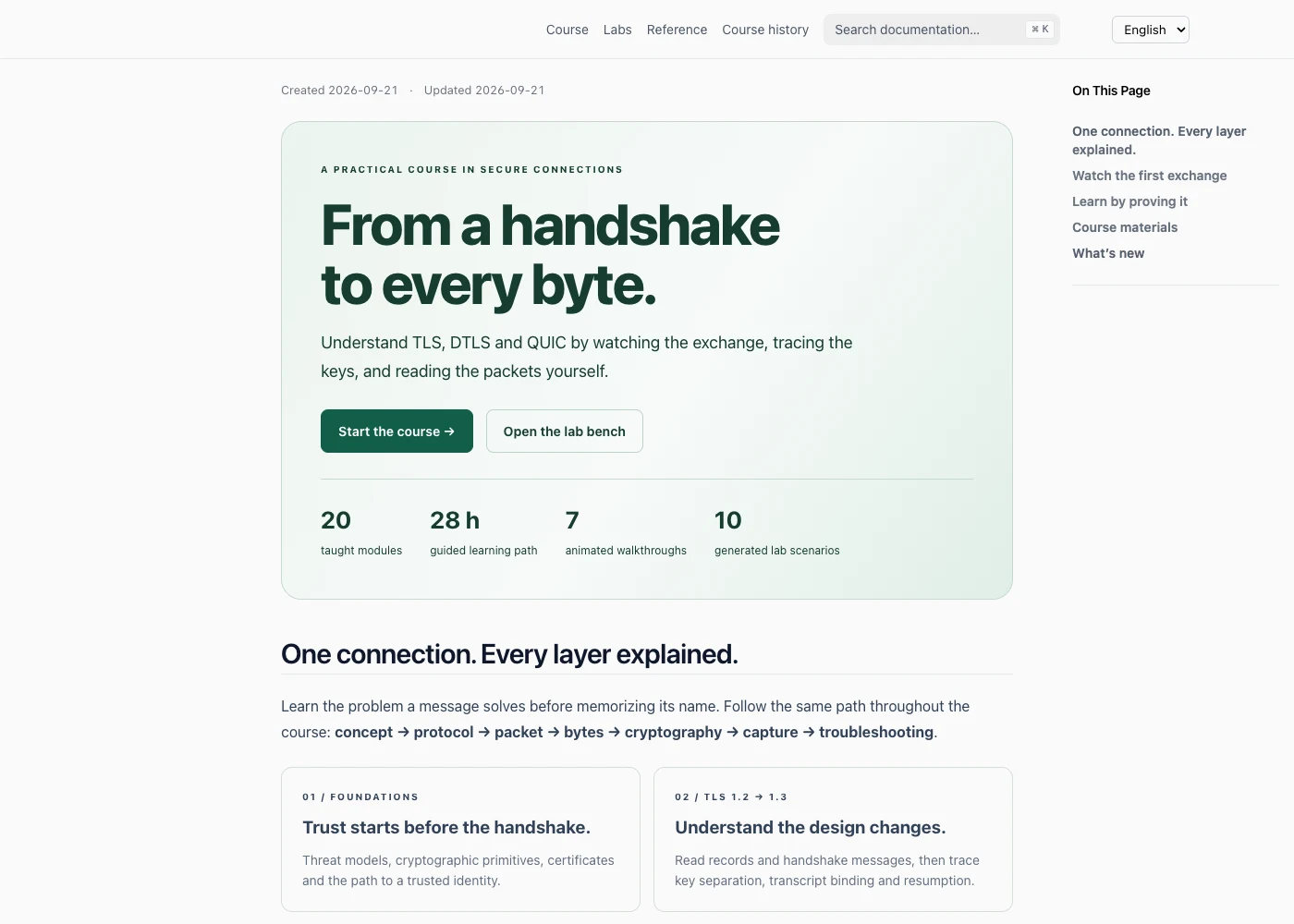
Learn TLS, DTLS and QUIC by watching the exchange, tracing the keys and reading the packets yourself — from first principles to decrypted captures.
- Duration
- 28 hours, labs included
- Lessons
- 20 modules and a capstone
- Self-check sections
- 20
- Animations
- 7
- Format
- Self-paced in the browser, or taught over four days; labs run in Docker or on a lab bench an instructor assigns
The course takes one secure connection apart, layer by layer — concept, protocol, packet, bytes, cryptography, capture, troubleshooting — and asks the learner to prove each claim from evidence rather than from a label in a packet list. Twenty modules run from what TLS promises and how a certificate earns trust, through TLS 1.2 and TLS 1.3 byte by byte and the TLS 1.3 key schedule, to DTLS on datagrams that get lost and TLS 1.3 inside QUIC and HTTP/3. A lab bench generates fresh captures with their matching key logs, so learners decrypt their own traffic in Wireshark, and a capstone asks them to explain a connection they have not seen before — first without the keys, then with them.
One animation from the material
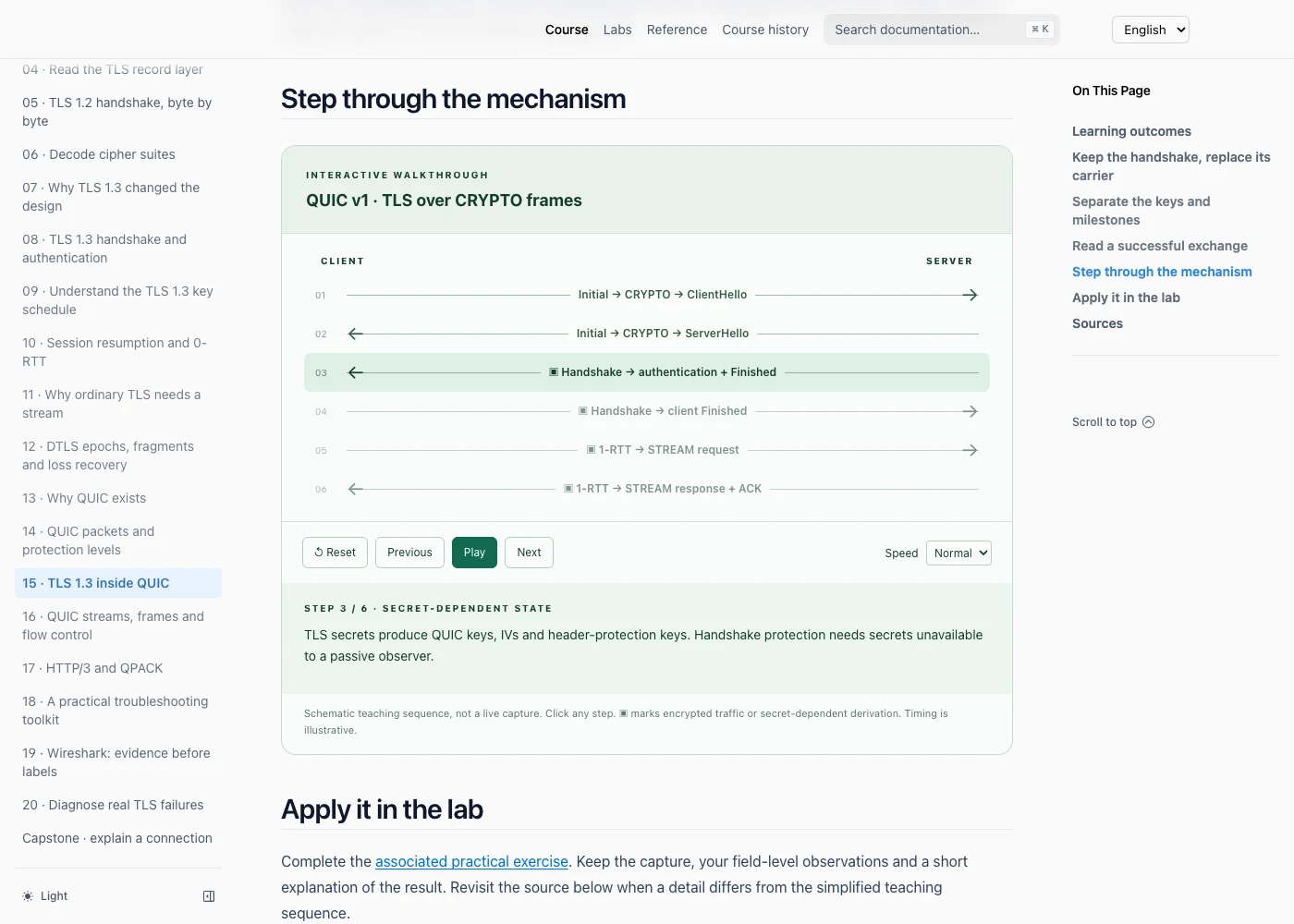
TLS 1.3 inside QUIC, step by step
Ported from the course's own interactive walkthrough “QUIC v1 · TLS over CRYPTO frames”, which accompanies its QUIC modules 13–17. The six steps, their arrows, the ▣ mark on secret-dependent steps and every explanation are the course's own words: Initial keys come from public inputs, so an observer can read the first flight, while everything after needs secrets TLS derives. In the course the learner clicks through with Play, Previous, Next and a speed control; here the steps advance by themselves on a loop and can only be paused.
Who it is for
- Network and security engineers who troubleshoot TLS failures and need to say why a handshake broke, not only that it did
- System administrators and developers who run HTTPS, certificates or HTTP/3 services
- Analysts who read encrypted traffic in packet captures and must separate what is visible from what is protected
- Instructors teaching secure protocols to a group, with a four-day plan and a capstone rubric already written
Before you start
- Comfortable with IP addresses, ports, TCP and UDP, basic command-line work and HTTP requests and responses.
- No advanced mathematics: the cryptography is taught by what each operation is for, not by its proofs.
- Wireshark on your own machine, and Docker to run the lab bench — or a lab bench in the browser if your instructor assigns one.
- Comfortable reading in English: the course and its pages are in English.
What you will be able to do
- Separate confidentiality, integrity and authentication, and say what a successful encrypted connection does not prove.
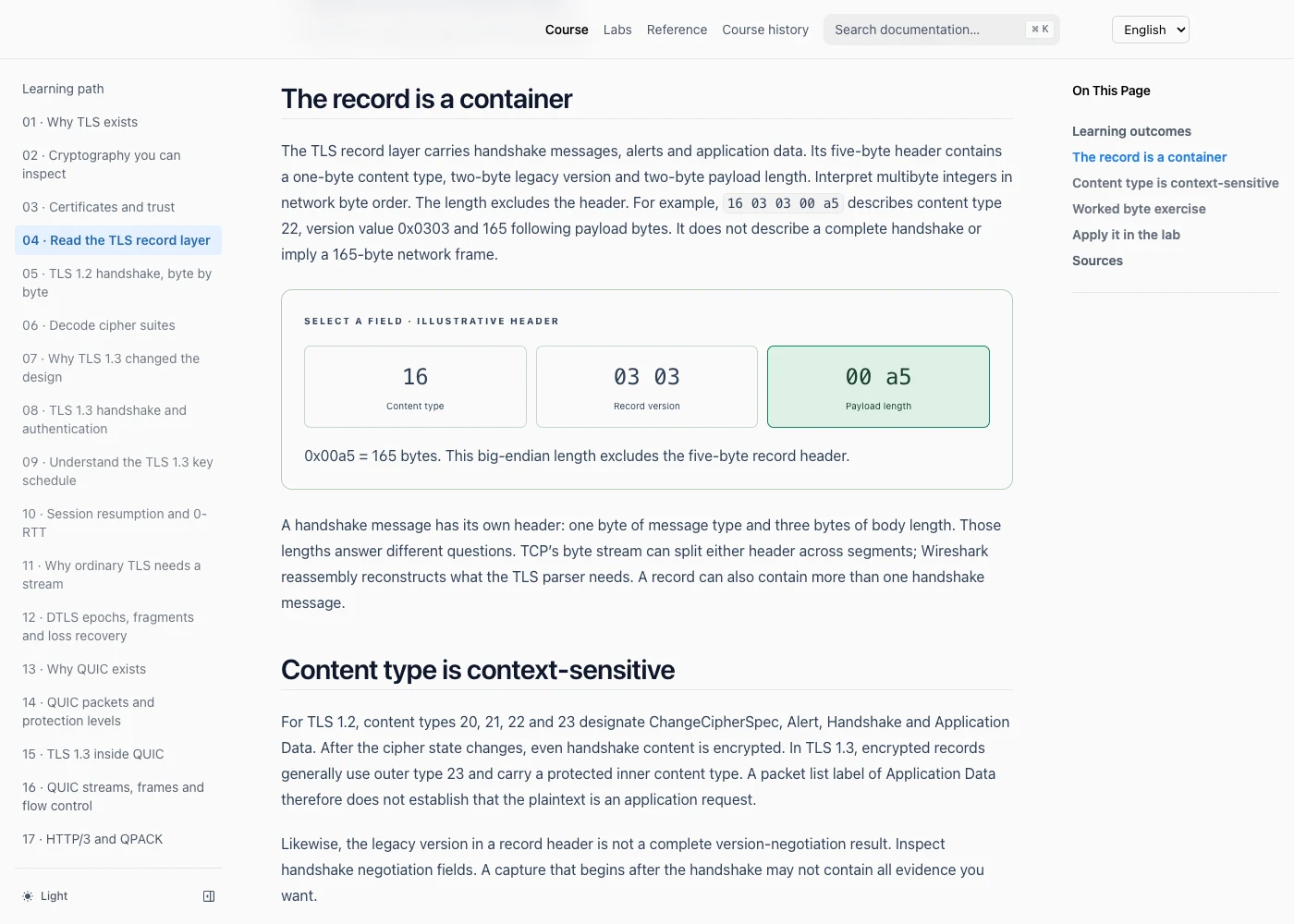
- Decode a TLS record header, trace a TLS 1.2 ECDHE handshake byte by byte and read a cipher-suite name correctly.
- Name the purpose of every major TLS 1.3 message and explain how the key schedule derives separate keys from one handshake.
- Tell a session ticket from an accepted resumption, and resumption from 0-RTT, using the fields that prove each.
- Read DTLS epochs, fragments and a handshake flight retransmitted after a lost datagram.
- Find the TLS 1.3 handshake inside QUIC CRYPTO frames, explain why Initial packets are readable, and prove HTTP/3 from ALPN and decoded frames.
- Decrypt your own captures with the matching key log, and diagnose hostname, trust, version and client-certificate failures from evidence.
Curriculum
Part and lesson titles appear exactly as they do in the course, in the course's own language; the line under each part is the question it answers.
Foundations
What does TLS actually promise, and which cryptographic parts is it built from?
- 01 · Why TLS exists
- 02 · Cryptography you can inspect
PKI
Why should a client believe a certificate?
- 03 · Certificates and trust
TLS 1.2
What is inside a record, and what happens byte by byte in a TLS 1.2 handshake?
- 04 · Read the TLS record layer
- 05 · TLS 1.2 handshake, byte by byte
- 06 · Decode cipher suites
TLS 1.3
What did TLS 1.3 change, where do its keys come from, and what is resumption really?
- 07 · Why TLS 1.3 changed the design
- 08 · TLS 1.3 handshake and authentication
- 09 · Understand the TLS 1.3 key schedule
- 10 · Session resumption and 0-RTT
DTLS
How does TLS survive on datagrams that can be lost or reordered?
- 11 · Why ordinary TLS needs a stream
- 12 · DTLS epochs, fragments and loss recovery
QUIC
How does QUIC carry TLS 1.3, and how do you prove a connection is HTTP/3?
- 13 · Why QUIC exists
- 14 · QUIC packets and protection levels
- 15 · TLS 1.3 inside QUIC
- 16 · QUIC streams, frames and flow control
- 17 · HTTP/3 and QPACK
Troubleshooting
How do you diagnose a connection from evidence rather than from the labels a tool prints?
- 18 · A practical troubleshooting toolkit
- 19 · Wireshark: evidence before labels
- 20 · Diagnose real TLS failures
- Capstone · explain a connection
Labs
Can you generate the evidence yourself, and read it with and without the keys?
- 01 · Docker setup
- 02 · Cryptography
- 03 · TLS 1.2 and 1.3
- 04 · Resumption
- 05 · Failures and mTLS
- 06 · DTLS and packet loss
- 07 · QUIC and HTTP/3
- 08 · Wireshark analysis
Appendices
- Glossary
- TLS 1.2 → 1.3 workshop
- Instructor guide
- Sources and attribution
- Validation and scope
Assessment
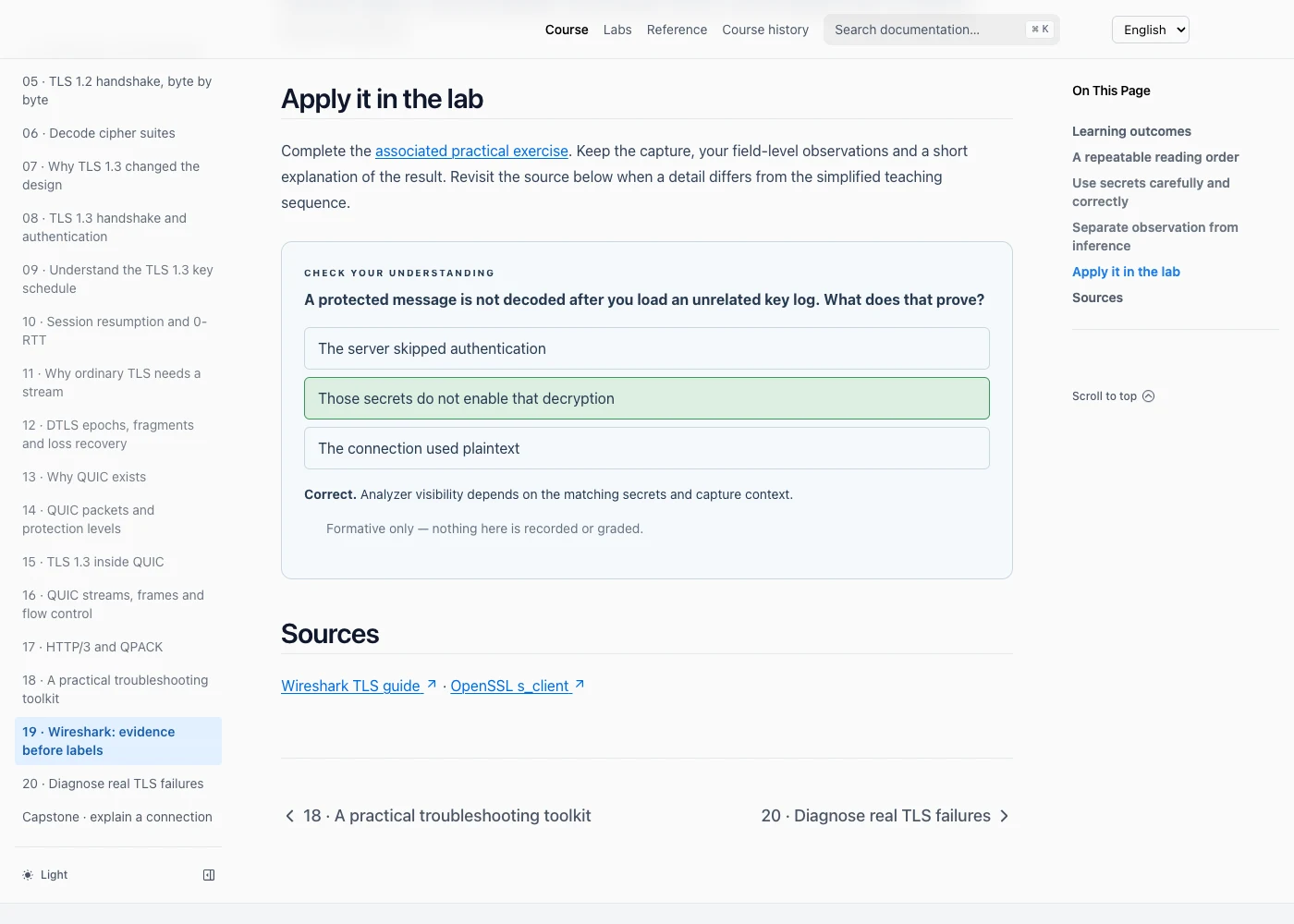
Each of the 20 modules ends with a knowledge check whose explanation appears as soon as the right answer is chosen; the checks are formative practice and are neither graded nor recorded. The lab bench is the practical test: 10 scenarios generate real captures and check their own evidence — 4 of them pass by reproducing a connection that is supposed to be refused. The capstone is the assessment: explain an unlabelled capture first without its keys, then with them, then diagnose a failure, marked against a five-part rubric out of 100 with a suggested pass mark of 80.
Sample pages
Captured from the course's own build. The platform's sign-in controls and the learner's personal panels are left out of the frame; everything else is the page as a learner sees it.
The duration is the course's own plan: 28 hours in eight units, covering reading, demonstrations, guided labs, discussion and assessment, with the labs counted inside that figure rather than added to it. Taught to a group it runs over 4 days of 7 contact hours; self-paced learners may take longer, and the platform records each learner's actual engaged time.
Run this course for your people
In a pilot the course runs on elmo beside your own material, and for every learner the platform records enrolment, progress through each page and engaged time, whatever the course's own format.